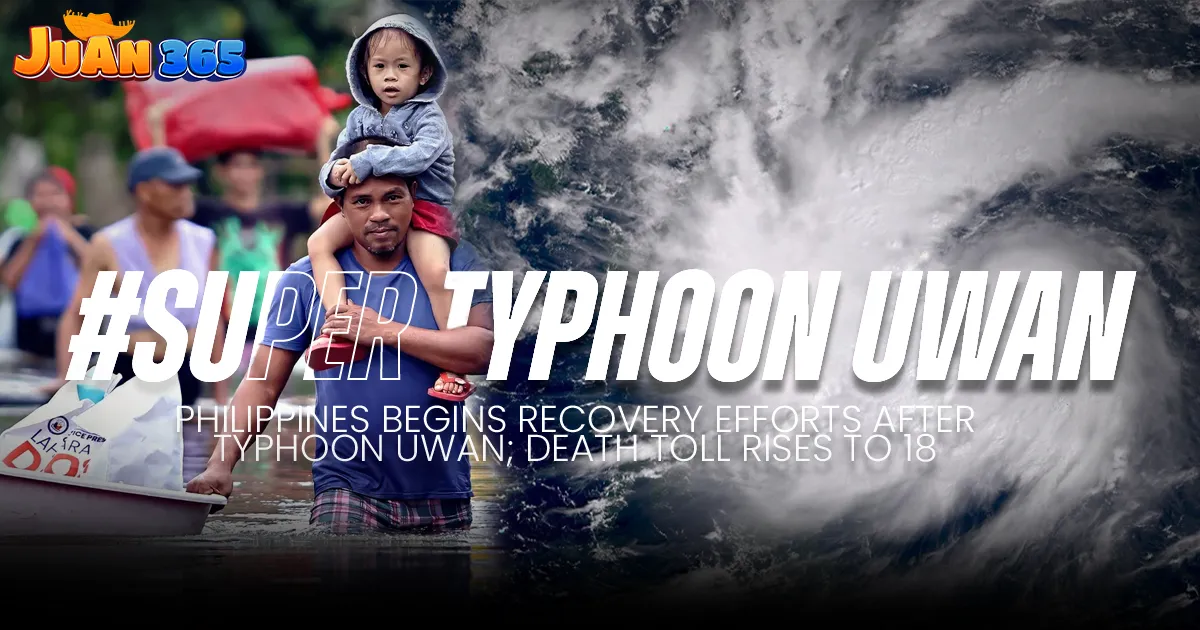
TUGUEGARAO CITY, Philippines — Uwan Death Toll Rises to 18 as rescue teams and local government units across Luzon race to clear debris, restore lifelines, and deliver aid to thousands of displaced families. Using backhoes, chainsaws, and boats, rescuers began digging out communities buried by floods and landslides on Tuesday, while the storm’s remnants moved north toward Taiwan, bringing with it heavy rain and strong winds.
The Philippine government confirmed that Typhoon Uwan displaced more than 1.4 million Filipinos, submerging hundreds of towns and damaging homes, roads, and farmlands. Though Uwan weakened into a severe tropical storm before leaving the Philippine Area of Responsibility (PAR), its aftermath remains catastrophic.
Typhoon Uwan’s Trail of Destruction
The Uwan Death Toll Rises to 18 after several days of torrential rainfall and flash flooding across Northern Luzon. Authorities have confirmed that most of the casualties came from:
- Cagayan and Apayao provinces, where flash floods forced residents onto rooftops.
- Nueva Vizcaya, where saturated soil triggered deadly landslides.
- Catanduanes island, where storm surges sent waves crashing into coastal villages.
- Samar province, where one of the storm’s earliest fatalities was recorded.
Witnesses described Typhoon Uwan as one of the strongest storms they have ever experienced. “The water rose so quickly, we didn’t think it would reach our homes,” said Mark Lamer, a 24-year-old from Tuao, Cagayan. “It was terrifying — everything happened in minutes.”
Government Response and Relief Operations
President Ferdinand Marcos Jr. has ordered full-scale relief and rehabilitation efforts across affected regions. He also announced that the existing state of national calamity, originally declared after Typhoon Tino, will be extended for another year to allow faster disaster response and fund mobilization.
Key agencies leading the recovery include:
- Department of Social Welfare and Development (DSWD) – distributing over 100,000 food packs, hygiene kits, and temporary shelters.
- Department of Public Works and Highways (DPWH) – clearing operations for national roads and bridges obstructed by landslides.
- Armed Forces of the Philippines (AFP) and Philippine Coast Guard (PCG) – deploying rescue teams, helicopters, and cargo planes for relief delivery.
- Department of Energy (DOE) – coordinating power restoration in affected municipalities.
- Department of Health (DOH) – providing medical assistance and preventing waterborne diseases in evacuation areas.
In Catanduanes, the restoration of clean water supply may take up to 20 days, according to local authorities. Health workers are also conducting vaccination drives to prevent outbreaks of leptospirosis and diarrhea in temporary shelters.
Economic and Agricultural Impact
Preliminary government estimates reveal that agricultural losses could exceed ₱1.2 billion, primarily in rice-producing provinces such as Cagayan, Isabela, and Nueva Ecija. Thousands of hectares of farmland remain submerged, while livestock losses continue to rise.
The Department of Agriculture (DA) is preparing an emergency recovery package that includes seed distribution, fertilizer support, and zero-interest credit loans for affected farmers. Economic analysts warn that these back-to-back typhoons — Uwan and Tino — could have a short-term impact on food prices, particularly in Northern and Central Luzon.
Environmental Concerns and Climate Factors
Meteorologists say the Uwan Death Toll Rises to 18 partly due to the storm’s rapid intensification, a phenomenon increasingly linked to climate change. Warmer ocean temperatures allow tropical cyclones to strengthen faster, while the atmosphere’s higher moisture content produces heavier rainfall.
Experts from PAGASA and the Climate Change Commission emphasized the need to improve:
- Early warning systems and localized weather advisories.
- Flood-control infrastructure and river management projects.
- Public education campaigns on disaster preparedness and evacuation.
The Sierra Madre mountain range once again played a crucial role in mitigating Uwan’s impact by absorbing much of its initial wind force. However, deforestation and unregulated mining continue to weaken natural barriers that protect inland communities.
Humanitarian Crisis and Recovery Outlook
As Uwan Death Toll Rises to 18, thousands of survivors now face the challenge of rebuilding. Many have lost homes, livelihoods, and personal belongings. The DSWD confirmed that more than 1,200 evacuation centers remain open, accommodating displaced families from Northern Luzon to the Bicol region.
Civil defense authorities estimate that full recovery could take several months, depending on weather conditions and available funding. Reconstruction priorities include:
- Rebuilding damaged homes and schools in flood-prone areas.
- Repairing major road networks to reconnect isolated communities.
- Restoring utilities such as electricity and water supply.
- Providing livelihood aid for farmers, fisherfolk, and small business owners.
The PCSO and other government agencies are also coordinating community assistance programs to help fund medical care and infrastructure rehabilitation.
Lessons and Long-Term Preparedness
The twin tragedies of Typhoons Tino and Uwan have reignited discussions about disaster resilience in the Philippines — one of the most typhoon-prone nations in the world. Experts urge stronger coordination between the public and private sectors to develop long-term mitigation strategies.
Key recommendations include:
- Strengthening local disaster response capacity and community drills.
- Implementing stricter zoning laws to prevent building in high-risk areas.
- Investing in renewable energy and sustainable agriculture to reduce environmental vulnerability.
- Enhancing real-time monitoring systems for faster evacuations.
Despite the devastation, stories of heroism and unity continue to emerge. Volunteers, local officials, and ordinary citizens are working together to rebuild — a testament to the Filipino spirit of resilience.
Moving Forward
As the Uwan Death Toll Rises to 18, the government faces the dual challenge of rebuilding lives and preparing for future storms. Recovery will take time, but officials remain committed to ensuring that no community is left behind.
Typhoon Uwan serves as both a tragedy and a reminder — of nature’s power and the nation’s capacity to endure. Even amid destruction, the Philippines continues to rise, driven by solidarity, compassion, and the determination to rebuild stronger than before.
Stay tuned at Juan 365 News for more updates!